BetterCMS vs custom coded
A hand built site has no licence fee, no vendor and no limits. The content lives in the repository, a change is a pull request, and the people who can change it are the people who can already ship code. For a small site that rarely changes, that is a good trade and it should stay that way.
It stops being a good trade the day a marketer has to ask an engineer to fix a typo. BetterCMS keeps the frontend you already wrote, through the Astro or Next adapter, and moves the words out of the repository and onto the page where anyone can edit them.
What a copy change costs
The rows a team actually argues about, including the ones we lose. BetterCMS and a hand built site with no CMS, compared across nine capabilities. The cost of a hand built site is engineering time, so no figure is quoted for it.
Scroll the table sideways to see every column.
| Capability | BetterCMS | Custom coded, no CMS |
|---|---|---|
| Who can change the copy | Anyone with an editor role | Anyone who can open a pull request |
| How a change ships | Publish, with an approval stage if you want one | Commit, review, merge, deploy |
| Design control | Your own components, with typed props | Total. It is your code |
| Licence cost | A plan, published | None |
| Structured content | Typed models, references, URL folders | Whatever you built. Often strings in components |
| Roles and approvals | Yes. Stages, assignees, field level roles | Code review, which is the same idea for a different job |
| Forms | Modelled, rendered, gated by Turnstile | A service you wire up and maintain |
| Markdown twins and llms.txt | Yes. Every page, on every plan | Only if you built them |
| Three person team, monthly | About $48, site included | No licence. The cost is engineering time |
There is no vendor on the right hand side and so no price to check. What a hand built site costs is whatever your team spends keeping it current, which only your team can work out. The BetterCMS figure is the one behind the homepage cost figure: about $48 a month for three people billed yearly, the Starter plan plus two Workspace members, site included.
Where BetterCMS wins
All of it is about who has to be involved in a change.
-
A typo is not a deploy
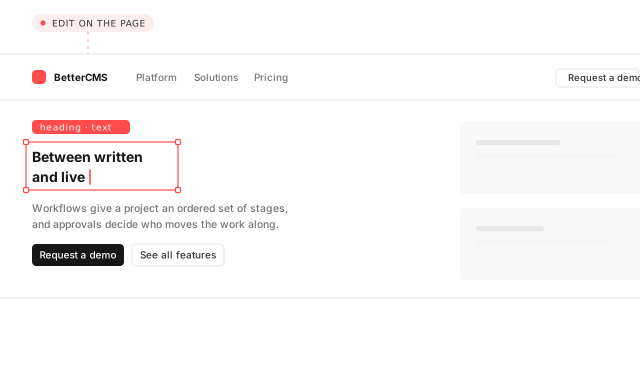
Changing a word on a hand built site means a branch, a review, a merge and a build. In BetterCMS it means clicking the word and typing.
-
Engineers get their week back
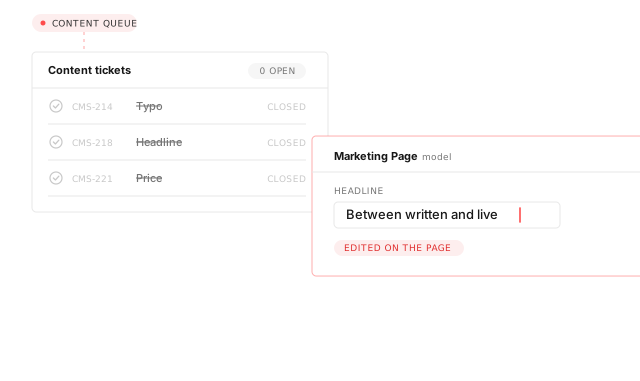
Most content tickets on a hand built site are not engineering problems. They are engineering interrupts. Moving the copy into a model ends them without ending anyone’s control of the layout.
-
Content that is actually structured
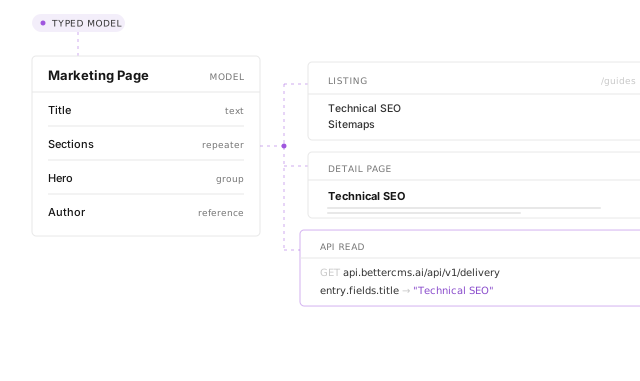
Strings in components cannot be listed, filtered or reused. A typed model can feed a listing, a detail page and an API read from one source.
-
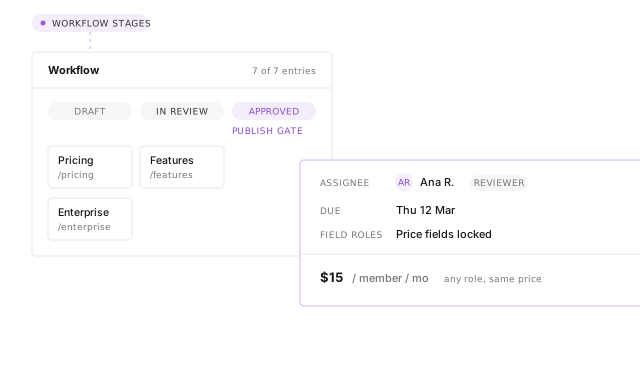
Approvals and flat member pricing
Stages, assignees and due dates are part of publishing, and every Workspace member is $15 a month whatever their role. Nobody needs a repository account to approve a sentence.
-
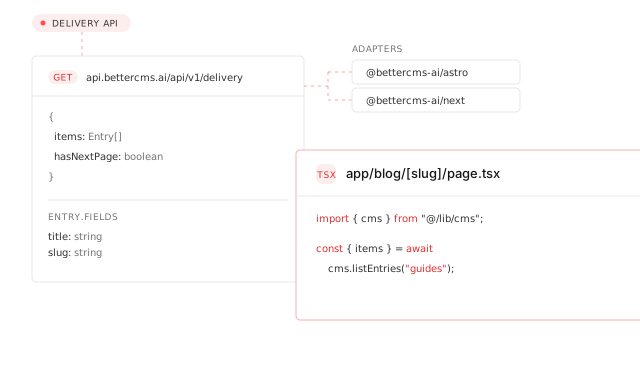
Keep the frontend you wrote
The Astro and Next adapters read BetterCMS content into the app you already have, so this is a content change rather than a rewrite. The SDK works from any framework over the REST Delivery API.
-
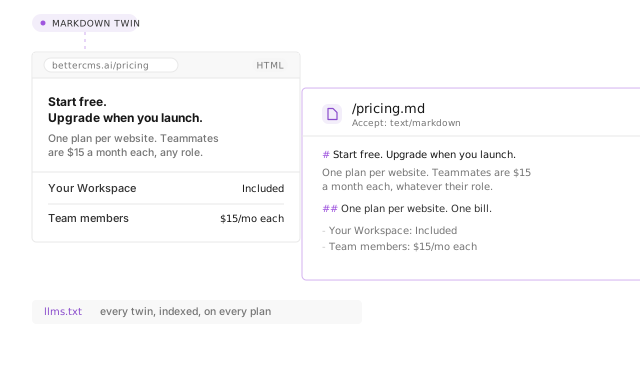
Answer engine output for free
Every BetterCMS page has a markdown twin and every site ships llms.txt, on every plan. On a hand built site both are something somebody has to build and keep current.
Where the hand built site wins
Four reasons the repository should keep the words.
-
There is no bill
No licence, no seats, no plan to outgrow. For a site that changes twice a year that is hard to beat, and we would not try to talk you out of it.
-
Nothing is in anyone else’s hands
No vendor roadmap, no platform limits, no migration if a company changes direction. Your site is a repository and it will still build in five years.
-
The model is exactly your model
A CMS asks you to express your content in its field types. Your own code expresses it in whatever shape the job actually has, with no translation layer in between.
-
Review is already solved
Pull requests, branch previews and a deploy history are a publishing workflow that your team already knows. A CMS gives you a second one to learn.
Keep the hand built site if content changes rarely, if the only people who change it are the people who can already ship code, and if nobody is waiting on an engineer to publish. The case for a CMS starts at the first person who is.
Moving copy out of the repository
You are not replacing the site. You are taking the words out of it.
-
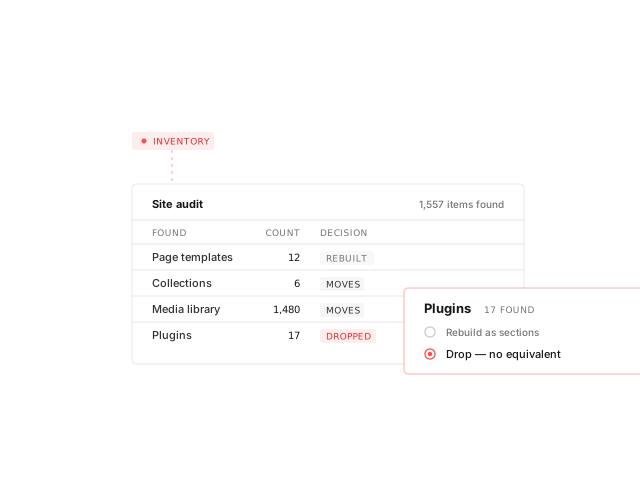
List what actually changes
Walk the pages and mark every string, image and link somebody has asked to change in the last year. That list is your content model, and it is usually much shorter than the codebase suggests.
Anything nobody has ever asked to change is layout. Leave it in the component.
-
Model it, then install the adapter
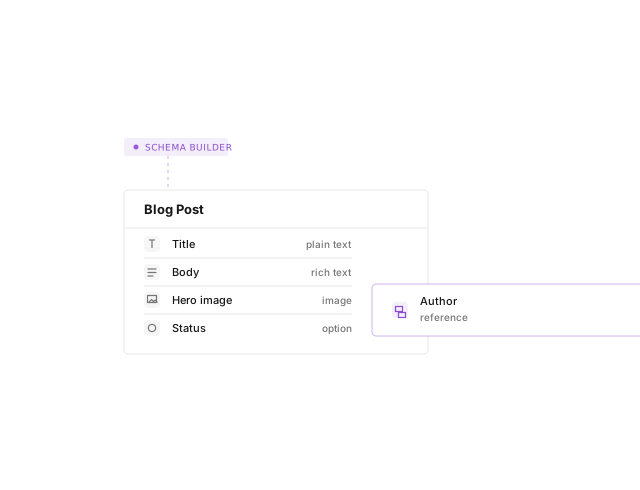
Build the models in the schema builder, then add the adapter for your framework. On Astro that is the integration and the loaders from the bettercms:client virtual module; on Next it is createBetterCMS with getEntry and listEntries.
terminal npm install @bettercms-ai/astro # or: npm install @bettercms-ai/next -
Generate the types
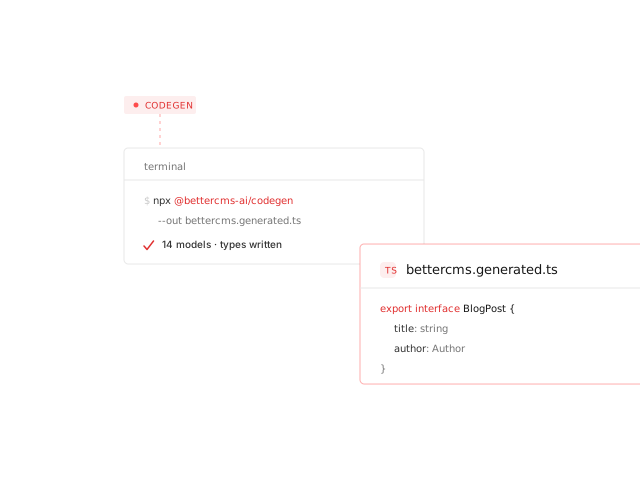
Run codegen so the components compile against the real models. A content move that does not type check is a content move you will debug in production.
terminal BETTERCMS_API_KEY=bcms_xxx npx @bettercms-ai/codegen \ --out src/bettercms.generated.ts -
Swap the strings for fields, one page at a time
Replace the hard coded strings with reads, page by page, and mark the elements with the click to edit attributes as you go.
There is no cutover day. Every page you convert is one fewer reason for a content ticket, and the ones you have not reached still work.
-
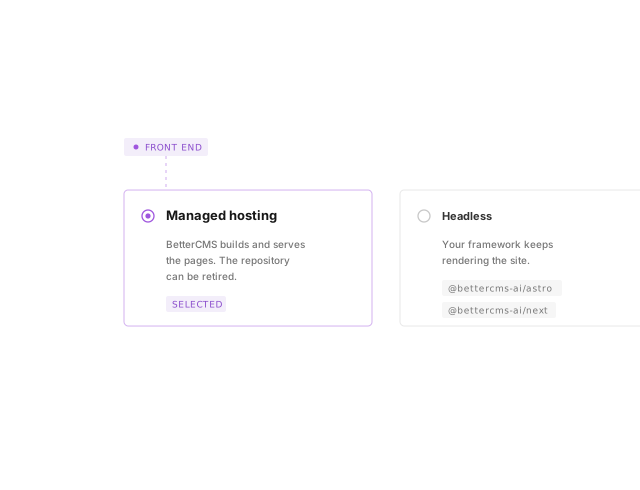
Decide whether the repository stays
You can keep the frontend and let it read from the Delivery API forever. Plenty of teams stop here.
Or let BetterCMS render and host the pages and retire the repository. That is the bigger win and the bigger decision, and it does not have to be made now.
Keep the deploy pipeline you have while you do this. Changing where the content lives and where the site builds in the same week is how a straightforward move becomes a bad fortnight.
Before you move
Do we need a CMS at all?
Not if the only people who change the site are the people who can already ship code, and the content changes rarely. A hand built site with the copy in the repository is a perfectly good answer and costs nothing in licences.
You need one at the point where somebody who cannot open a pull request has to change a word, and has to wait for somebody who can.
Do we have to rewrite the site to use BetterCMS?
No. The Astro and Next adapters read BetterCMS content into the app you already have, and the SDK works from any framework over the REST Delivery API.
The usual path is page by page: swap the hard coded strings for field reads, keep everything else. There is no cutover day.
What does BetterCMS take away from engineers?
The content tickets, and nothing else. Components, layout, routing and the deploy pipeline stay exactly where they are, and the props a section exposes are still declared by the person who wrote the section.
A marketer can change the words inside a section. They cannot change what the section is.
Can we get our content back out?
Yes. Content is readable through the REST Delivery API and the Management API, and every page also has a markdown twin.
That is worth checking before any CMS, not only this one. A hand built site has no lock in at all, and that is a genuine advantage it keeps.
Your next website starts here
See BetterCMS running on your pages, not on a sample site.