BetterCMS vs DatoCMS
DatoCMS is a hosted headless CMS and it ships no website. Content lives behind its API and a frontend team builds, hosts and previews everything a visitor sees. BetterCMS renders and hosts the site, so the first publish does not wait on a build.
If you already run a frontend and want a clean GraphQL API behind it, DatoCMS is a good fit and we would not argue. If nobody on the team is free to build a website, a headless API is a project rather than a CMS.
Headless CMS against website product
The rows a buyer actually asks about, including the ones we lose. BetterCMS and DatoCMS compared across nine capabilities. This page quotes no DatoCMS price.
Scroll the table sideways to see every column.
| Capability | BetterCMS | DatoCMS |
|---|---|---|
| Website included | Yes. Rendered and hosted | No. You build and host the frontend |
| Visual editing on the page | Yes. Edit on the rendered page | No. Forms in a hosted admin, plus preview links |
| Content model | Typed models, references, groups, repeaters | Typed models, references, modular blocks |
| Media handling | Media transform endpoint, width, format, quality, fit | Own image CDN with on the fly transforms |
| Forms and SEO in the box | Yes. Forms, SEO panel, markdown output | No. Build them, or add plugins |
| Markdown twins and llms.txt | Yes. Every page, on every plan | No. Build it yourself |
| MCP control of the CMS | Yes. Native server, scoped keys, human roles | Their Management API, scripted by you |
| Three person team, monthly | About $48, site included | Not quoted here. See their pricing page |
We publish a competitor price only where we have checked it ourselves, and we have not checked DatoCMS. Read their pricing page rather than this one. The BetterCMS figure is the one behind the homepage cost figure: about $48 a month for three people billed yearly, the Starter plan plus two Workspace members, site included.
Where BetterCMS wins
The content model is not the argument. The website is.
-
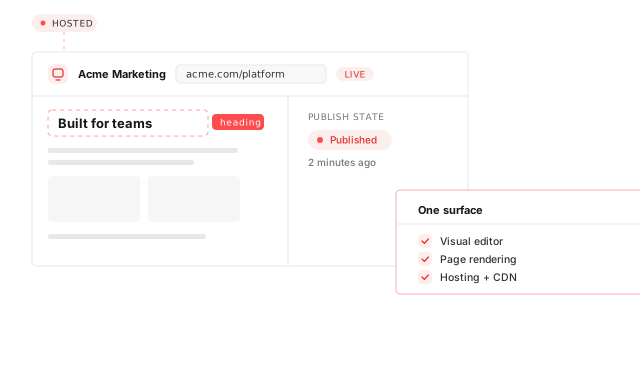
There is a website
A DatoCMS project needs a frontend, a framework, hosting and preview wiring before a marketer publishes anything. BetterCMS renders and hosts the site, so the first publish happens on day one rather than after the build.
-
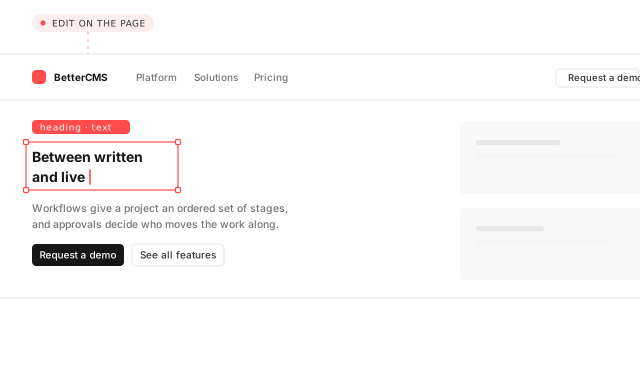
Editing on the page
BetterCMS edits happen on the rendered page: click the heading, change the heading. A headless admin gives an editor a form and a preview of a build somebody else owns.
-
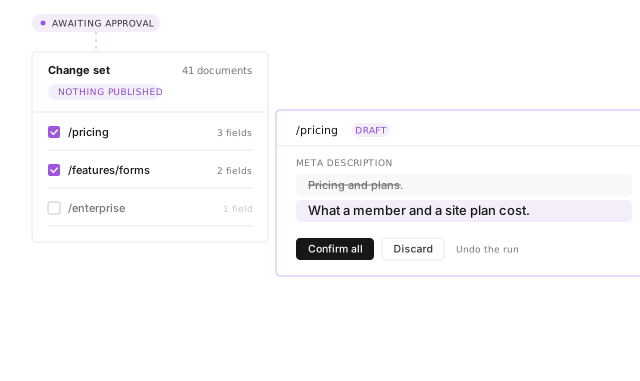
An agent that operates the site
The BetterCMS agent proposes changes across many documents inside the editor a marketer already uses, and every field shows before and after with undo.
-
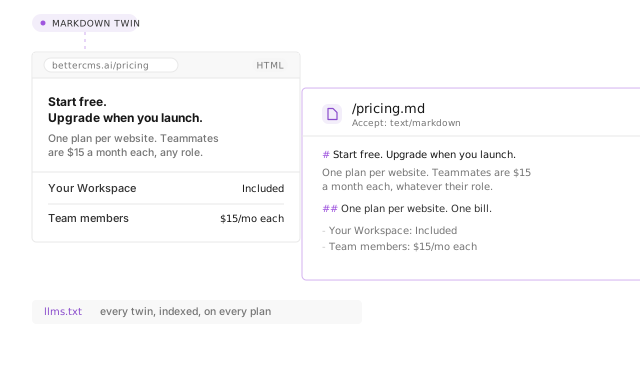
Answer engine output
Every BetterCMS page has a markdown twin and every site ships llms.txt, on every plan. A headless CMS has no opinion about how the site renders, so that output is work for your team.
-
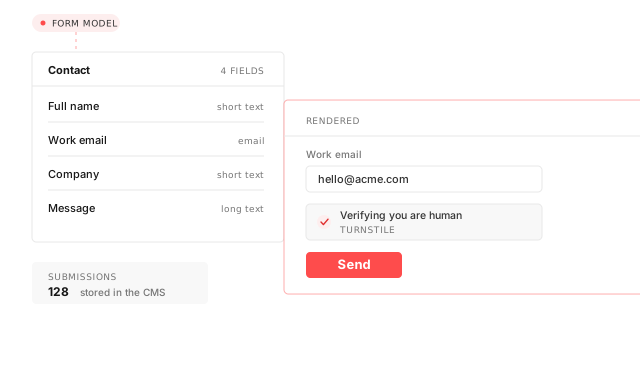
Forms without a service
Forms are modelled, rendered and gated by Turnstile inside BetterCMS. On a headless stack a form is a third party service plus an endpoint somebody maintains.
-
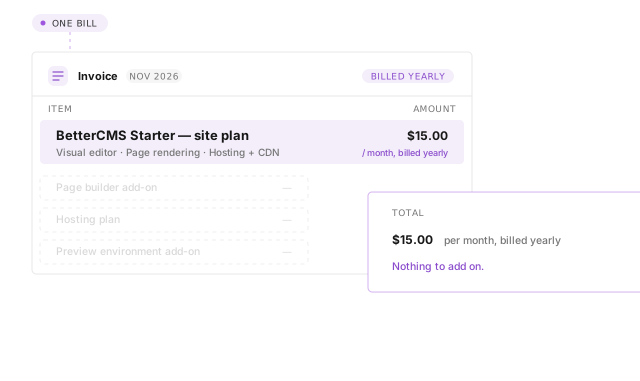
One bill, one surface
The BetterCMS line covers the editor, the rendering and the hosting. Price a headless stack as the CMS plus the frontend build plus wherever it runs.
Where DatoCMS wins
Three, and the first of them is a whole query language we do not have.
-
GraphQL, and we have none
DatoCMS delivers content over a GraphQL API. The BetterCMS Delivery API is REST and there is no GraphQL endpoint today. If your frontend is built around typed GraphQL queries, that is a real gap on our side.
-
Any frontend, any channel
Headless means the same content feeds a website, an app and a kiosk without caring what renders it. BetterCMS can do that through its Delivery API, but it is built around a site it renders itself.
-
Images are their craft
Asset handling and on the fly image transforms are a core part of what DatoCMS sells. BetterCMS has a media transform endpoint and it is a feature, not a specialism.
Pick DatoCMS if you have frontend engineers on payroll, if content feeds channels beyond one website, or if a GraphQL API is a requirement rather than a preference.
Moving from DatoCMS
The Migrator API does not cover DatoCMS, so this is a scripted move rather than a button.
-
Rebuild the models first
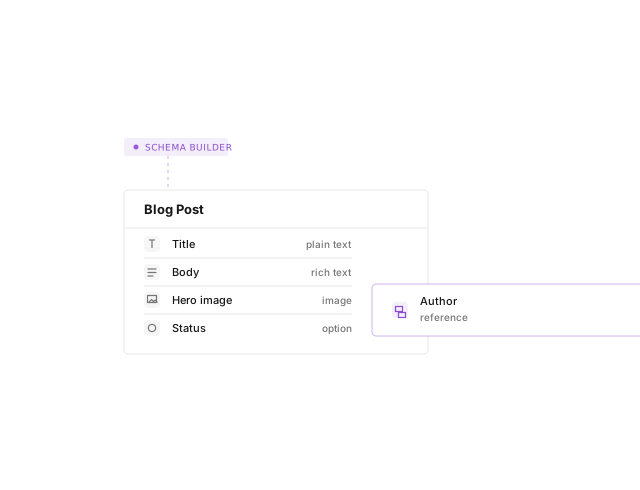
Recreate each DatoCMS model in the BetterCMS schema builder. The field types line up closely: plain text, rich text, image, reference, option.
Do this before you export anything. The model decides what the export has to become, and reshaping data twice is the expensive way round.
-
Export the records
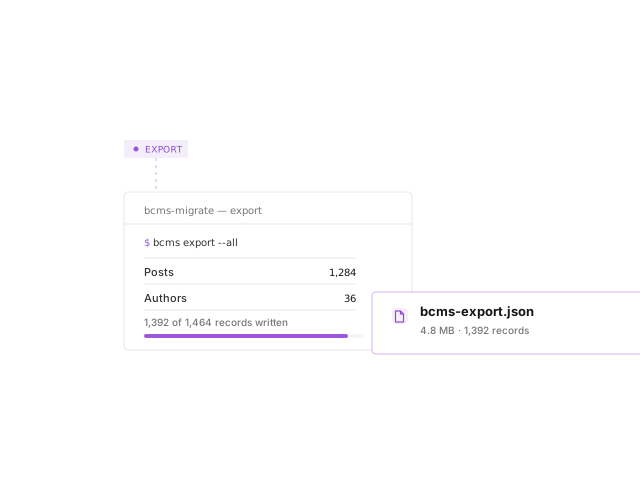
Read every record out through the DatoCMS Content Management API and write it to JSON. Keep the record ids: they are what lets you reconnect references after the load.
Modular blocks inside a record become the matching repeater or block field on the BetterCMS side.
-
Move the assets
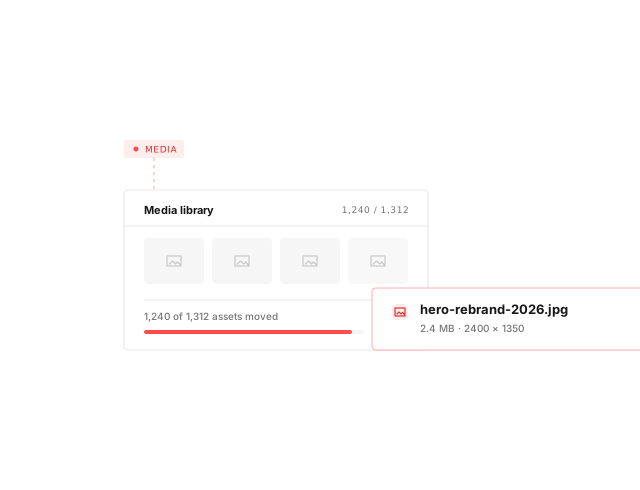
Upload the files to BetterCMS media and keep a map from the old asset id to the new one, then rewrite the references in the exported JSON before you load it.
-
Load through the Management API
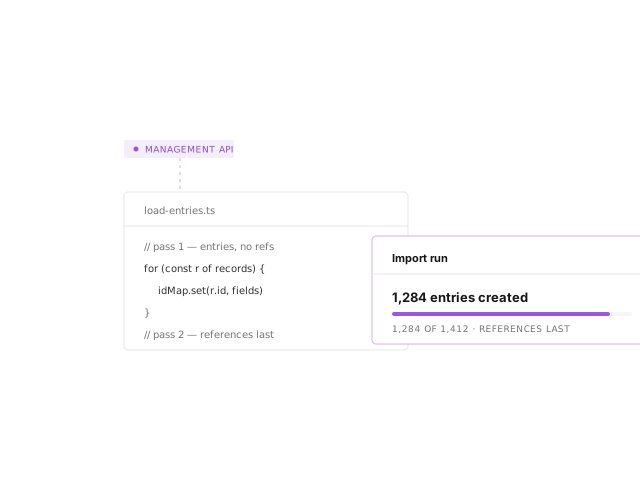
Create the entries with the BetterCMS Management API, references last, so every target already exists when a reference is written.
Then run codegen so the frontend compiles against the real models rather than against your memory of the old schema.
terminal BETTERCMS_API_KEY=bcms_xxx npx @bettercms-ai/codegen \ --out src/bettercms.generated.ts -
Keep the URLs
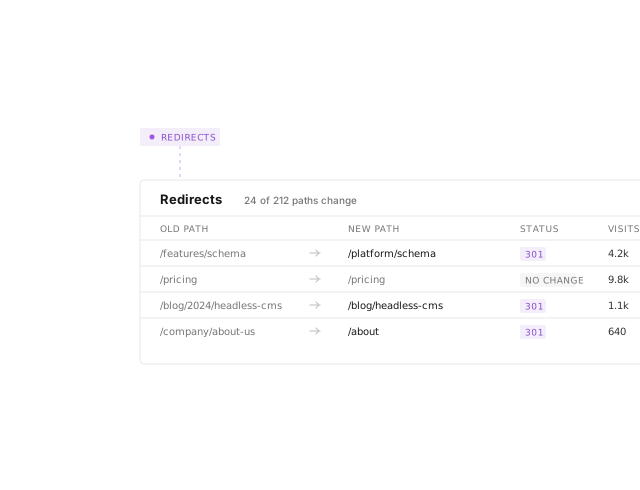
List every live URL first and map each one to its new path, then set the redirects before you move the DNS.
This is the step teams skip and then spend a quarter recovering search traffic from.
Be honest about the queries. If your frontend leans on deep GraphQL projections, the read layer is a rewrite and not a swap, because the BetterCMS Delivery API is REST.
DatoCMS questions
Is BetterCMS an alternative to DatoCMS?
Only if you want a website out of it. DatoCMS is a content platform and BetterCMS is a content platform with the site attached, so the real question is whether you have a frontend team to spare.
For content feeding several applications rather than one site, a headless CMS is the stronger choice and we would say so on a call.
Does BetterCMS have a GraphQL API?
No. The BetterCMS Delivery API is REST, and there is no GraphQL endpoint today. DatoCMS delivers content over GraphQL.
If your frontend is built around typed GraphQL queries, that is the first thing to check before switching.
Can BetterCMS import content from DatoCMS?
Not in one click. The Migrator API covers WordPress, Contentful and Sanity today, and DatoCMS is not one of them.
A DatoCMS move means rebuilding the models, exporting the records through their Content Management API, moving the assets, and loading everything through the BetterCMS Management API. The content part is a script. The frontend part is the project.
Is BetterCMS cheaper than DatoCMS?
We do not publish a DatoCMS price, because we have not checked one. Read their pricing page.
What we can say is what the two bills cover. A BetterCMS site plan includes the editor, the rendering and the hosting, and a headless CMS bill does not include the frontend that goes in front of it.
Your next website starts here
See BetterCMS running on your pages, not on a sample site.