BetterCMS vs WordPress
WordPress is free software with an ecosystem nothing else can match, and its real cost is hosting, plugin licences and the person who keeps them all compatible. BetterCMS is one product with one bill, where structured content, roles, approvals, an AI agent and markdown output are built in rather than assembled.
If a plugin does something nothing else does, or you have a WordPress developer on staff, WordPress is the right answer. If the maintenance is the part you want to stop paying for, that is the trade this page is about.
Plugin by plugin, or in the box
On WordPress, "partial" almost always means a plugin exists. That is the point of the column. BetterCMS and WordPress compared across nine capabilities. The WordPress column describes self hosted WordPress with typical plugins. The BetterCMS cost is for three people billed yearly.
Scroll the table sideways to see every column.
| Capability | BetterCMS | WordPress |
|---|---|---|
| Ecosystem | Small. A young product | Unmatched. A plugin exists for everything |
| You own the code and the data | Content is exportable. The platform is not yours | Yes. Open source, self hosted, no licence |
| Structured content | Yes. Typed models, references, URL folders | Partial. Custom field plugins on a blog engine |
| Approval workflow | Yes. Stages, assignees, due dates | Partial. A plugin, and its update schedule |
| Field level roles | Yes | Partial. Role plugins, uneven quality |
| AI agent with review | Yes. Reviewed field by field, undoable | Partial. WordPress.com assistant, or plugins |
| MCP control of the CMS | Yes. Native server, scoped keys | Partial. Community servers, uneven |
| Markdown twins and llms.txt | Yes. Every page, on every plan | Partial. Plugins |
| What it costs to run | One subscription, about $48 for three people | Free licence, plus hosting, plugins and upkeep |
WordPress cost figures were checked in July 2026: managed hosting $20 to $35 a month, paid plugins $50 to $300 a year each, WordPress.com Business $33 a month. The software itself is free and always will be. Prices move. Check them again before you rely on one.
Where WordPress wins
Four reasons the incumbent usually wins, and often should.
-
The ecosystem, and it is not close
Any feature you can name exists as a WordPress plugin, and any freelancer you hire already knows the admin. BetterCMS has a smaller surface and a smaller hiring pool. If your site depends on one specific plugin, that plugin is a reason to stay.
-
You own everything
Open source, self hosted, no licence fee, and your database is yours. BetterCMS is not open source and no phrasing makes it so. What we offer instead is portability: the content comes out over an API and the frontend is never locked to us.
-
Twenty years of content
Migration inertia is real. If a site has fifteen years of posts, custom taxonomies and editorial habits built around them, the cost of moving is genuine and it belongs on the WordPress side of the ledger.
-
It can be free
Self hosted WordPress on cheap hosting with free plugins costs almost nothing. We are not going to argue we beat that on price, and any vendor who does is counting your time as worthless.
Stay on WordPress if a plugin does something nothing else does, if a WordPress developer is already on staff, or if open source ownership is a hard requirement.
Where BetterCMS wins
The argument is not price. It is how many moving parts a small team should be responsible for.
-
Nothing to keep compatible
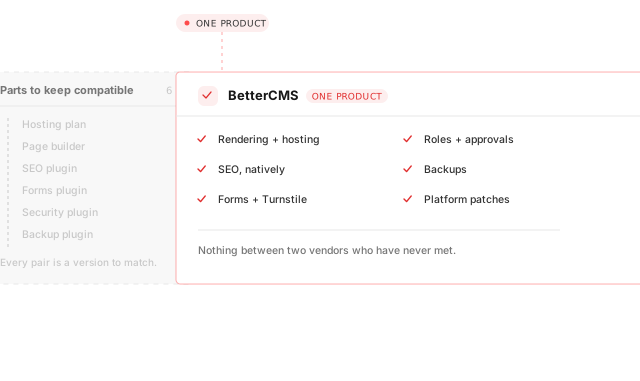
A WordPress stack is a hosting plan, a page builder, an SEO plugin, a forms plugin, a security plugin, a backup plugin and a compatibility matrix between them. In BetterCMS those are the product, so a release cannot break the interaction between two vendors who have never met.
-
Structured content, natively
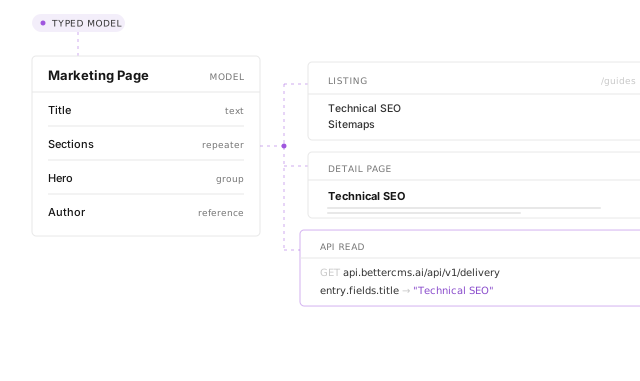
Structured content in WordPress is a custom fields plugin bolted onto a blog engine. In BetterCMS a model is a model: typed fields, references, nested groups, and collections that live in real URL folders.
-
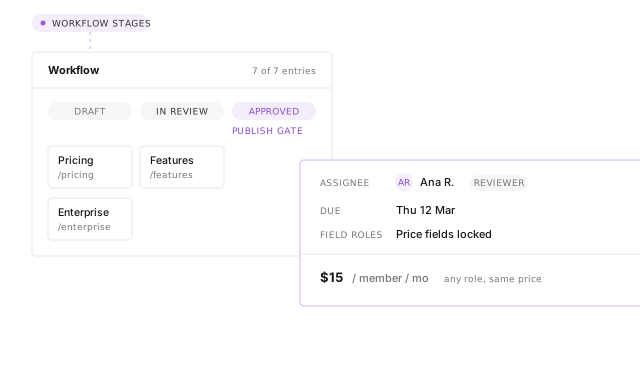
Governance is built in
Approval stages, assignees, due dates, field level roles and audit logs ship as part of publishing. On WordPress each of those is a plugin decision with its own update risk.
-
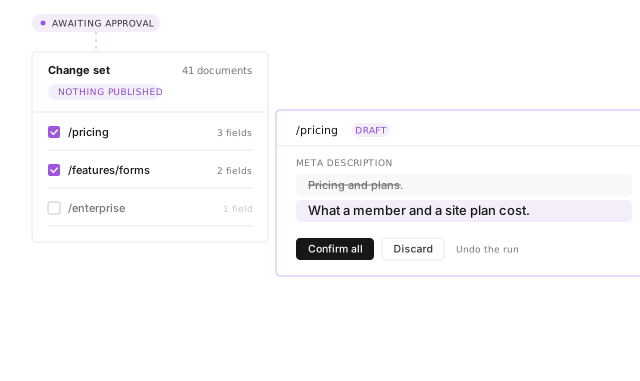
An agent under CMS discipline
WordPress AI is fragmented: the WordPress.com assistant on its own hosted plans, and a hundred plugins of wildly varying quality everywhere else. The BetterCMS agent works inside roles and review, and hands every change back for approval with undo.
-
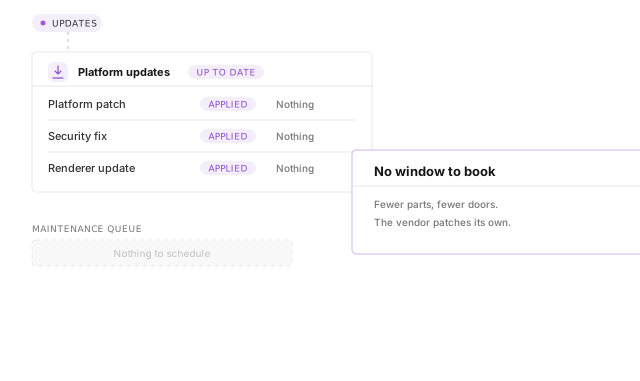
Security posture
Most WordPress incidents arrive through a plugin. Fewer parts means fewer doors, and BetterCMS patches its own without asking you to schedule it.
-
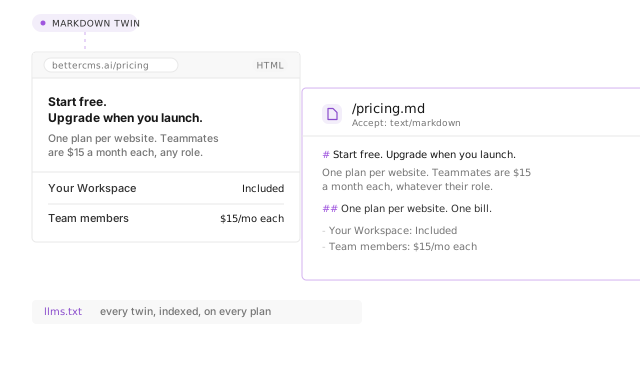
Answer engine output
Markdown twins and llms.txt on every page and every plan, rather than a plugin that may or may not still be maintained next year.
Moving from WordPress
WordPress is one of the three platforms the Migrator API covers. Posts and media are the easy half; the plugins are the half that needs a decision.
-
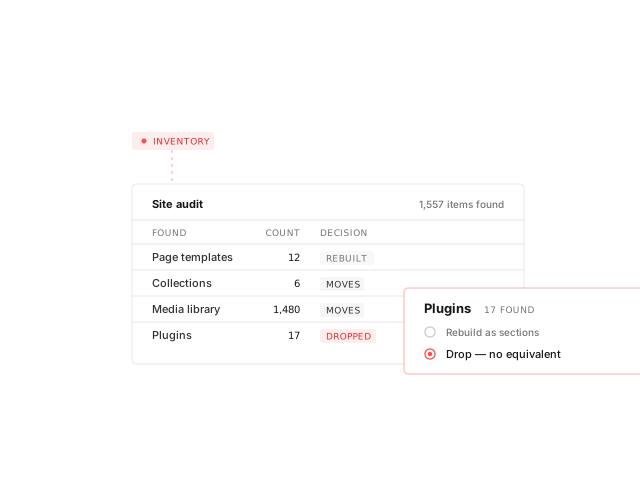
Inventory the plugins first
List every active plugin and write down what it actually does for the site. Most map onto something BetterCMS ships: forms, SEO, redirects, roles, backups.
The ones that do not are the decision. If a plugin is load bearing and has no equivalent, that is a reason to stay and it is better found now than in week three.
-
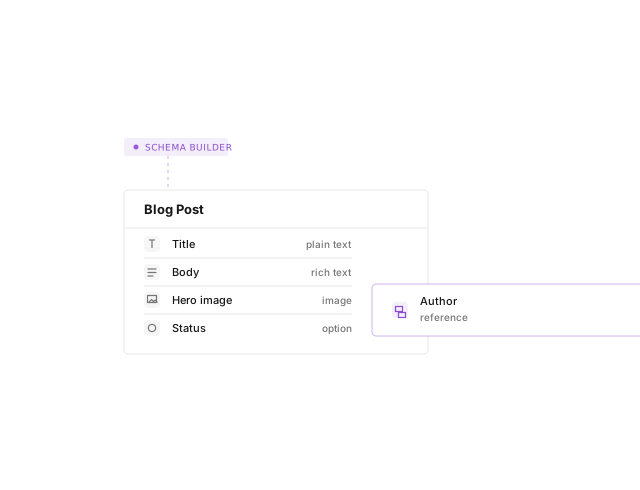
Model the content types
Posts, pages, custom post types and their custom fields become BetterCMS models. Taxonomies become references.
A WordPress site that grew organically usually has three content types pretending to be one. Split them here.
-
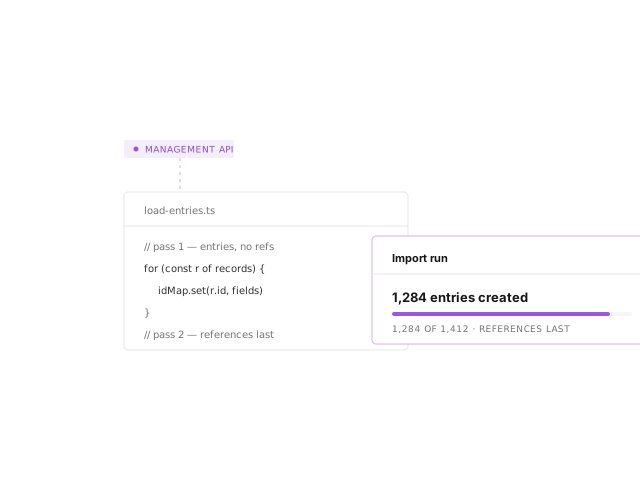
Run the Migrator
The Migrator API maps the existing schema onto BetterCMS collections and brings entries and media across.
Post content arrives as rich text. Shortcodes do not survive, because nothing on the other side executes them.
-
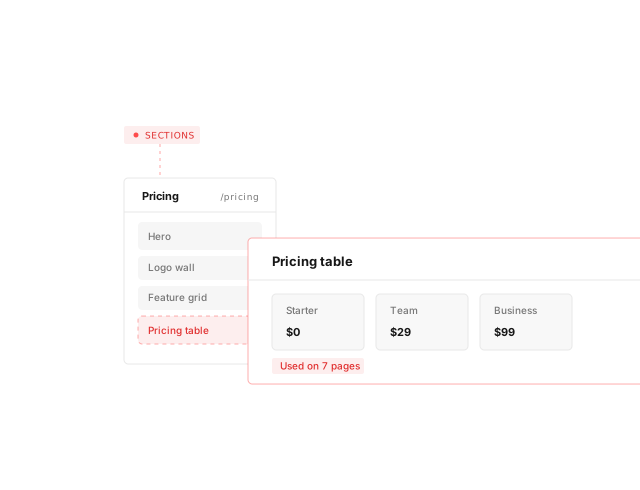
Rebuild the theme as sections
A WordPress theme is templates plus PHP. A developer defines the equivalent BetterCMS sections once, and marketers compose pages from them afterwards.
-
Keep the URLs
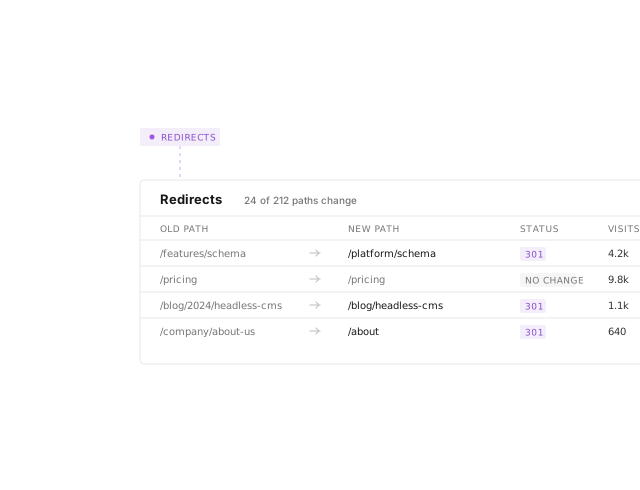
Export the full URL list, map every one onto its new path, and set the redirects at your host before the DNS moves. A fifteen year old WordPress site has more live URLs than anybody expects.
Shortcodes and page builder markup are the two things that always cost more than planned. Search the database for both before you quote the work.
Leaving WordPress
Is BetterCMS cheaper than WordPress?
Not against a free licence, and we will not pretend otherwise. Self hosted WordPress with free plugins costs the price of hosting.
Against a real stack the comparison changes. Managed hosting at $20 to $35 a month, plus paid SEO, forms, security and backup plugins at $50 to $300 a year each, plus the hours somebody spends patching them, lands most teams between about $60 and $150 a month before their own time. A three person BetterCMS setup is about $48 a month billed yearly, Starter plus two Workspace members, with no maintenance line. Checked July 2026.
Is BetterCMS open source?
No. BetterCMS is a commercial product and no phrasing makes it open source.
What it does offer is portability. Content is readable over a typed Delivery API and exportable, and the frontend is never locked to us: you can run headless and host the site anywhere. If owning the source is a hard requirement, WordPress or Payload is the honest recommendation.
Can BetterCMS import a WordPress site?
Yes. WordPress is one of the three platforms the Migrator API covers, alongside Contentful and Sanity. It maps posts, pages, custom post types and media onto BetterCMS collections.
Two things do not come across: shortcodes, because nothing executes them on the other side, and page builder markup, because it is a layout format rather than content. Search the database for both before you plan the work.
Does WordPress have an AI agent?
Partly. WordPress.com added an AI assistant in February 2026 that edits content and layouts on its own hosted plans, and Automattic has Telex, a free and experimental AI block builder. The self hosted ecosystem has a hundred AI plugins of uneven quality.
What is missing across all of them is the discipline: roles, review, audit and undo. That is what the BetterCMS agent runs inside, and it is the difference between an assistant and an operator.
Your next website starts here
See BetterCMS running on your pages, not on a sample site.