BetterCMS vs Sanity
Sanity is the deeper content platform and it ships no website. Everything a visitor sees has to be built, hosted and wired for preview by a frontend team you employ. BetterCMS ships the editor, the hosting, the SEO surface and the forms in the box, so a marketer can publish before an engineer writes a line.
If you have frontend engineers and content feeding several products, Sanity is the stronger foundation. If the website is the product and nobody is free to build one, Sanity is a project rather than a CMS.
What each product actually ships
Two products that overlap on content modelling and share almost nothing else. BetterCMS and Sanity compared across nine capabilities. Monthly cost is for a three person team on one small marketing site, with BetterCMS billed yearly.
Scroll the table sideways to see every column.
| Capability | BetterCMS | Sanity |
|---|---|---|
| Content model depth | Typed models, references, groups, repeaters | Best in class. Schema as code, GROQ, portable text |
| Visual editing on the page | Yes. Edit on the rendered page | No. Forms in a studio, plus presentation preview |
| Website included | Yes. Rendered and hosted | No. You build and host the frontend |
| Forms and SEO in the box | Yes. Forms, SEO panel, markdown output | No. Build them, or add plugins |
| AI with review | Yes. Change sets reviewed field by field | Partial. Real, and developer facing |
| MCP control of the CMS | Yes. Native server, additive tools only | Partial. Agent Actions over the API |
| Markdown twins and llms.txt | Yes. Every page, on every plan | No. Build it yourself |
| Free viewers | No. Every member is $15 a month, whatever the role | Yes. Viewers are free |
| Three person team, monthly | About $48, site included | About $45, plus your own frontend |
Sanity figures were checked against Sanity public pricing in July 2026. The Sanity number excludes the cost of building and hosting the frontend, which every Sanity project needs and which is usually the larger line. Prices move. Check them again before you rely on one.
Where BetterCMS wins
The difference is not the content model. It is everything the visitor sees.
-
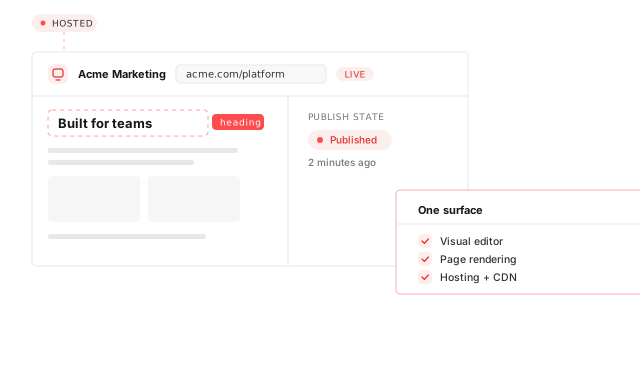
There is a website
A Sanity project needs a frontend team, a framework, hosting, and preview wiring before a marketer publishes anything. BetterCMS renders and hosts the site, so the first publish happens on day one rather than after the build.
-
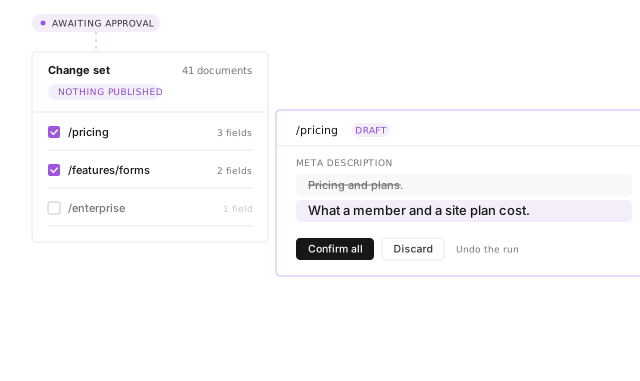
A marketer grade review UI
The BetterCMS agent proposes multi document change sets inside the editor a marketer already uses, and every field shows before and after with undo. Sanity Agent Actions run through APIs and a developer flavoured dashboard.
-
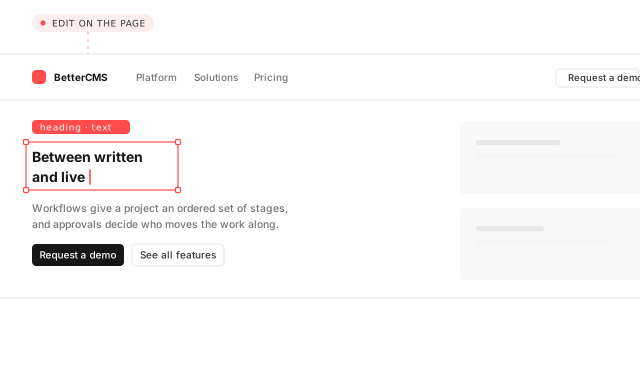
Visual editing, not a form
BetterCMS edits happen on the rendered page: click the heading, change the heading. Sanity gives an editor a form and a preview of a build somebody else owns.
-
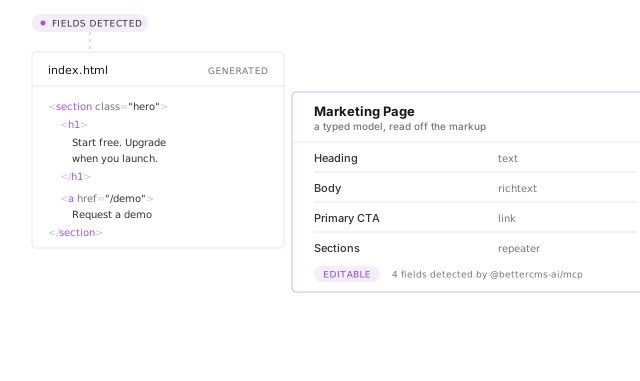
HTML to a live page
Hand a generated HTML page to the BetterCMS MCP server and it becomes a schema backed, editable page. There is no Sanity equivalent for that path.
-
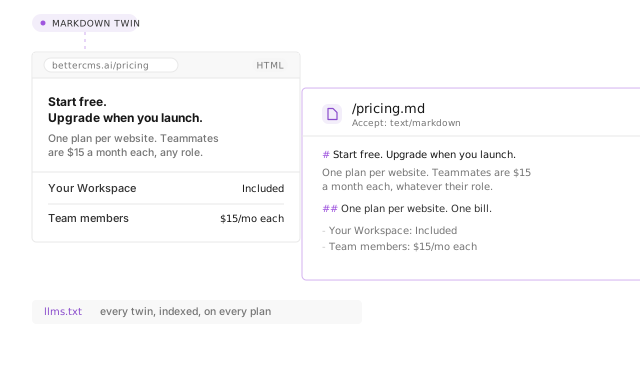
Answer engine output
Markdown twins and llms.txt ship with every BetterCMS site. On Sanity that is a thing your team builds, because Sanity has no opinion about how the site renders.
Where Sanity wins
Four rows where a content platform beats a website product.
-
The content model itself
Schema as code in your repository, GROQ for querying, portable text for rich content, and years of production use behind all three. For content feeding five applications, Sanity is the more battle tested model and BetterCMS is not close yet.
-
Their AI is real
Agent Actions, Canvas and the dashboard Content Agent shipped between spring 2025 and November 2025. This is not a competitor with a chat box bolted on, and treating it as one would be a mistake.
-
Ecosystem and infrastructure
A large plugin bench, real time collaboration infrastructure, and a hiring pool who already know it. Ours is smaller on all three counts.
-
Total schema control
Sanity schemas live in version control, review like code and deploy like code. BetterCMS models are edited in a schema builder and read out through codegen, which is not the same thing.
Pick Sanity if you have in-house frontend engineers, if content feeds channels beyond a website, or if schema in version control is a requirement rather than a preference.
Moving from Sanity
Sanity is one of the three platforms the Migrator API covers, so the content half of this is short. The frontend half is a decision, not a migration.
-
Decide whether the frontend moves
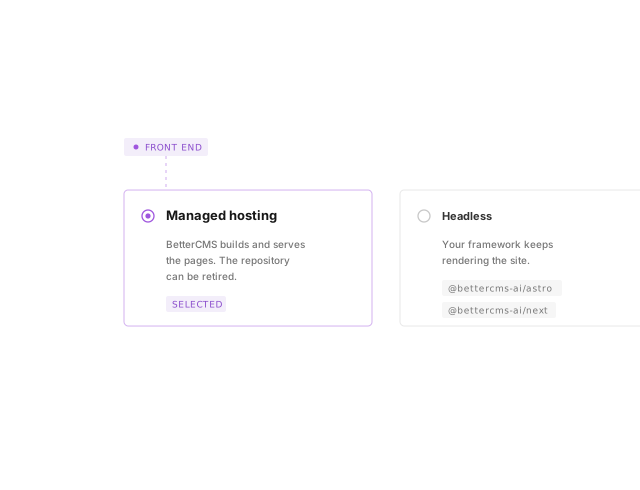
You can keep your existing Astro or Next.js frontend and point it at the BetterCMS Delivery API instead of Sanity. Nothing about the site has to change.
Or you can let BetterCMS render and host the pages and retire the frontend repository. That is the bigger win and the bigger decision.
-
Run the Migrator
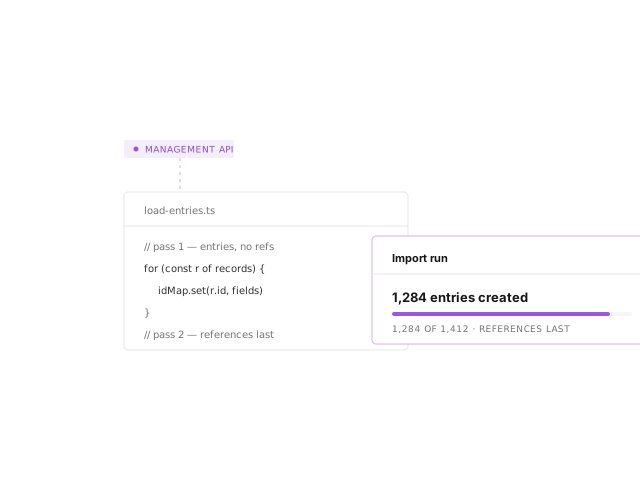
The Migrator API maps an existing Sanity schema onto BetterCMS collections and brings entries and assets with it.
Reference fields survive as references. Portable text arrives as rich text, which is the same specification on both sides.
-
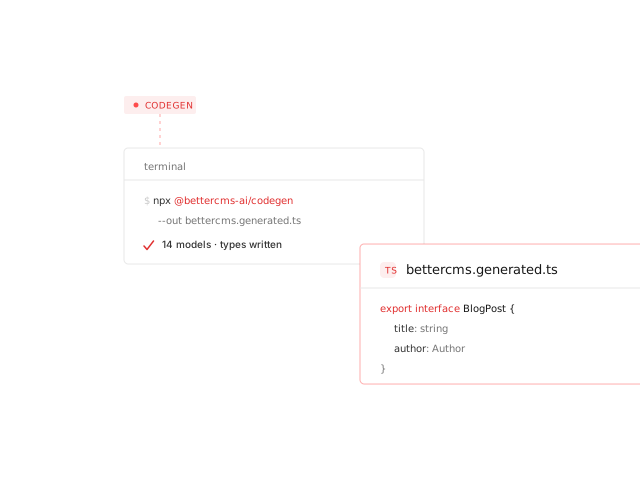
Regenerate the types
Run codegen against the new models so the frontend compiles against real types rather than against your memory of the old schema.
terminal BETTERCMS_API_KEY=bcms_xxx npx @bettercms-ai/codegen \ --out src/bettercms.generated.ts -
Swap the reads
Replace GROQ queries with the adapter for your framework. On Next.js that is getEntry and listEntries; on Astro it is the loaders from the bettercms:client virtual module.
This is the part that takes a sprint on a large site, because GROQ projections do more in one query than a REST read does.
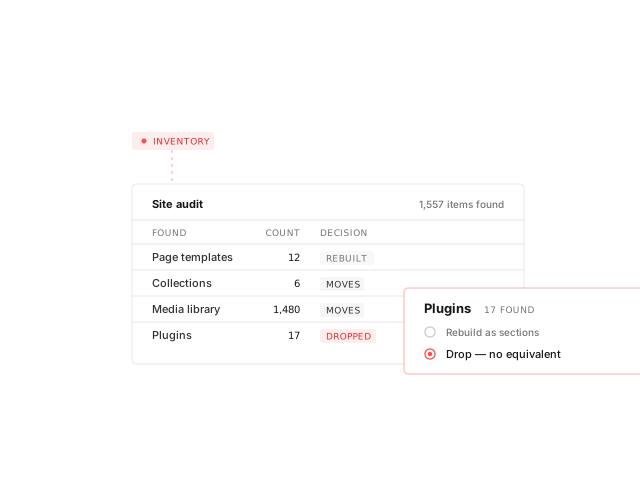
Be honest with yourself about GROQ. If your frontend leans on deep projections and joins, the read layer is a rewrite and not a swap.
Developer questions
Is BetterCMS an alternative to Sanity?
Only if you want a website out of it. Sanity is a content platform and BetterCMS is a content platform with the site attached, so the comparison is really "do we have frontend engineers to spare".
For pure omnichannel content feeding several applications, Sanity is the stronger choice and we would say so on a call.
Is BetterCMS cheaper than Sanity?
Not on the CMS line, where the two land within a few dollars. Sanity Growth is $15 per seat a month, about $12 billed annually, with viewers free, which puts three people near $45 a month. BetterCMS is about $48 billed yearly (Starter at $18 plus two members at $15), and Sanity is cheaper when most of your people only view. Checked July 2026.
The comparison changes when the frontend is priced in. A Sanity site still needs a framework build, hosting and preview wiring, and BetterCMS includes all three.
Does Sanity have a visual editor?
No, not in the sense of editing the rendered page. Sanity gives editors forms in a studio and a presentation preview of the site your developers built.
BetterCMS edits happen on the page itself. That difference is the main reason marketing teams move.
Can BetterCMS import content from Sanity?
Yes. Sanity is one of the three platforms the Migrator API covers, alongside WordPress and Contentful. It maps the existing schema onto BetterCMS collections and brings entries and assets across.
Portable text moves cleanly, because BetterCMS stores rich text against the same Portable Text specification.
Your next website starts here
See BetterCMS running on your pages, not on a sample site.