BetterCMS vs Payload
Payload is a framework for building a CMS and BetterCMS is a finished one. Payload is MIT licensed TypeScript that runs inside your Next.js repository, so an engineering team owns the schema as code, forks anything it dislikes and pays no licence.
BetterCMS ships the visual editor, the hosting, the approval workflow and the agent, so the people who are not engineers can run the site. The buyer for Payload is the engineer. The buyer for BetterCMS is the team that engineer supports.
Who writes the admin surface
Most differences on this table reduce to one question: who writes the admin surface. BetterCMS and Payload compared across nine capabilities. Payload is free to self host; the hosted tier is priced separately.
Scroll the table sideways to see every column.
| Capability | BetterCMS | Payload |
|---|---|---|
| Ownership | Commercial product. Content is portable | Yes. MIT, fork it, run it, own it |
| Schema as code in your repo | No. Schema builder, plus generated types | Yes. TypeScript config in your Next.js app |
| Visual editing on the page | Yes. Edit on the rendered page | No |
| Website rendered and hosted | Yes | No. You build and deploy the site |
| Approval workflow out of the box | Yes. Stages, assignees, due dates | No. Drafts and versions, then code |
| AI agent with review | Yes. Reviewed field by field, undoable | No operating agent today |
| MCP control of the CMS | Yes. Native server, additive tools only | No |
| Who maintains it | We do | You do |
| Licence and hosting | Subscription, hosting included | Free to self host. Cloud $35 to $199 a month |
Payload figures were checked in July 2026: MIT licence, free to self host, Payload Cloud from $35 to $199 a month, acquired by Figma in June 2025. The real cost of Payload is engineering time, which no pricing page states. Prices move. Check them again before you rely on one.
Where BetterCMS wins
Everything on this list is code somebody writes on a Payload project.
-
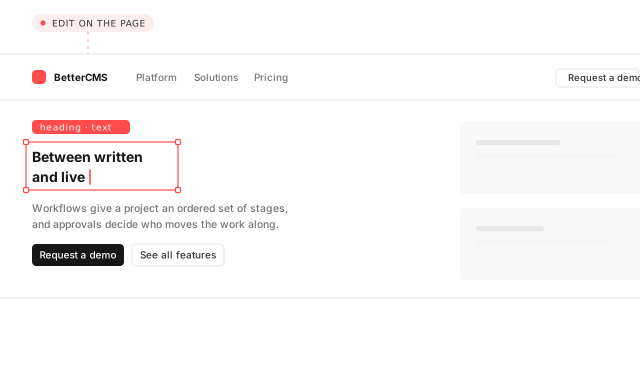
A marketer can edit the page
Payload has an admin panel and no visual site editor. BetterCMS edits happen on the rendered page, which is the difference between a marketer changing a headline and a marketer filing a ticket.
-
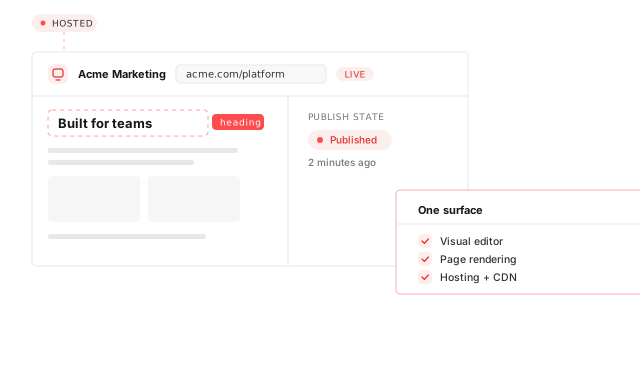
The site is hosted
Payload gives you a CMS to run. BetterCMS renders the pages, serves the media and runs the forms, so there is no second thing to deploy and keep up.
-
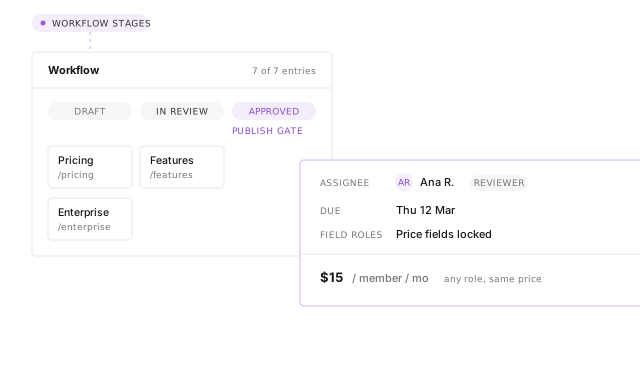
Approvals exist already
Stages, assignees, due dates and field level roles ship as part of publishing. On Payload, drafts and versions are there and the review process around them is yours to build.
-
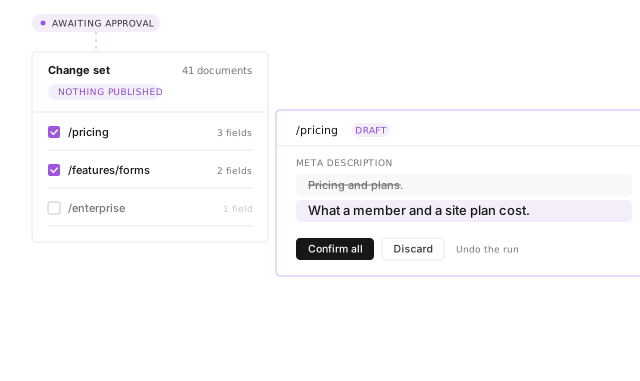
An operating agent
Payload enterprise plans mention AI features and there is no operating agent today. The BetterCMS agent proposes multi document change sets and waits for a field by field approval, with undo.
-
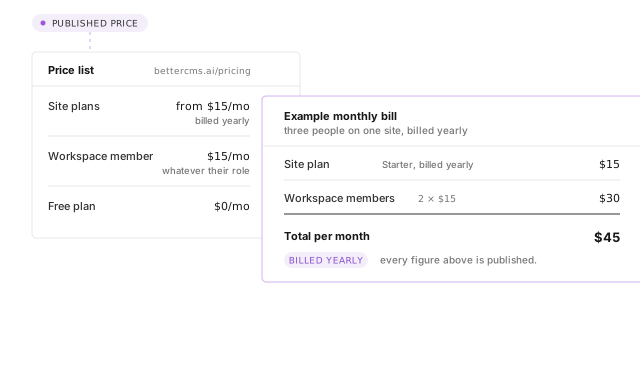
The cost that is not on the pricing page
Payload has no licence fee and a real cost: the engineering hours to build the admin surfaces, run the deployment and keep it patched. That number is larger than a subscription for most teams and it is invisible until it is not.
-
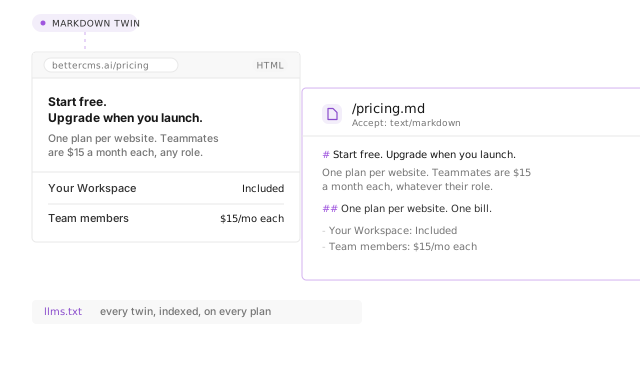
Answer engine output
Markdown twins and llms.txt ship with every BetterCMS site. On Payload it is a feature you write.
Where Payload wins
Four things you get by owning the admin panel as code.
-
Ownership, completely
MIT licence, your database, your deployment, no vendor bill and no vendor risk. If your engineering team wants to fork the admin panel on a Tuesday, Payload lets them. BetterCMS does not and will not.
-
Schema as code
Payload collections are TypeScript in the repository, so they review in a pull request and deploy with the app. BetterCMS models are edited in a schema builder and read out through codegen, which is a different and less git shaped workflow.
-
It lives inside Next.js
Since 3.0, Payload runs inside your Next.js app. One repository, one deploy, one set of types. For a team already on Next.js that is genuinely the cleanest arrangement available.
-
Extensibility without asking
Every admin surface is code you can change. In BetterCMS the surfaces are ours, and an unusual requirement is a support conversation rather than a component override.
Pick Payload if the team is engineering led, wants the CMS as code in its own repository, and has the hours to own it.
Moving from Payload
Both sides are typed and structured, so this is a script rather than a project. The interesting part is deciding what stops being code.
-
Translate the collections
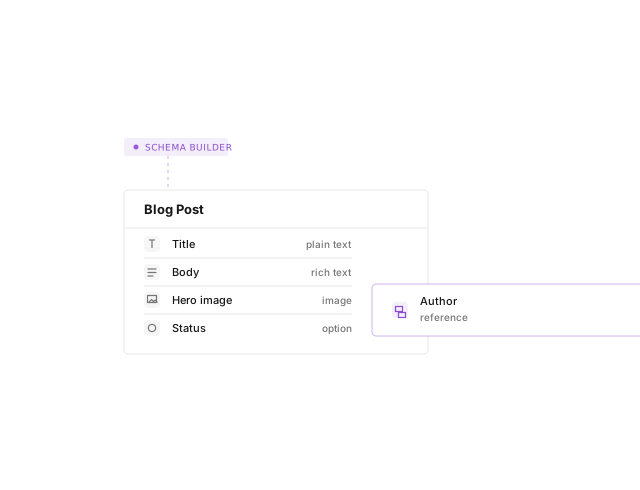
Payload collection configs map onto BetterCMS models field for field: text, richText, upload, relationship, array, group.
Rebuild them in the schema builder, or let an assistant do it over MCP, which is what the create_model and add_field tools are for.
-
Read out, write in
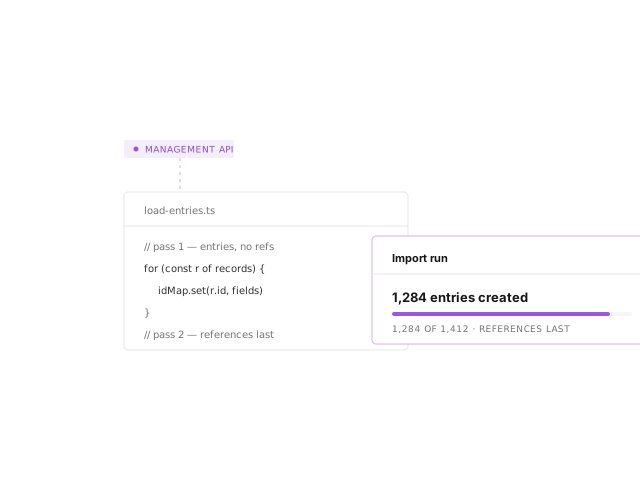
Read documents from the Payload Local API or REST API and write entries through the BetterCMS Management API.
Run it against a staging project first. Relationship fields need the target entries to exist, so order the writes.
-
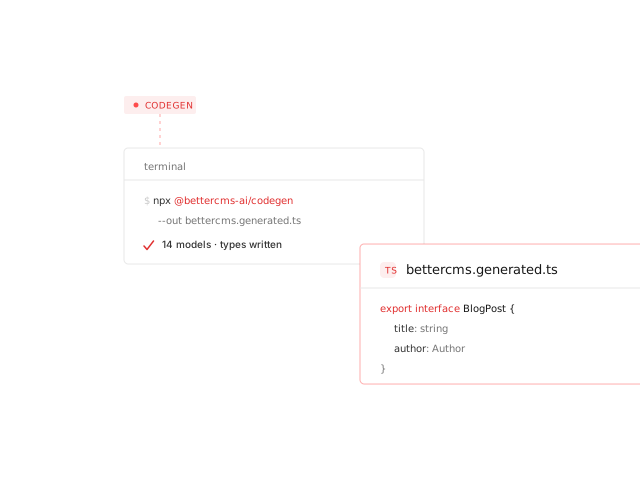
Regenerate the types
Payload generated your types from the config. BetterCMS generates them from the models, so the frontend keeps compiling against real types rather than against a memory of the old shape.
terminal BETTERCMS_API_KEY=bcms_xxx npx @bettercms-ai/codegen \ --out src/bettercms.generated.ts -
Decide what stops being code
Hooks, access control and custom admin components are the parts with no direct equivalent. Some become roles and permissions, some become webhooks, and some genuinely do not survive.
List them before you commit. This list is the whole risk in the move.
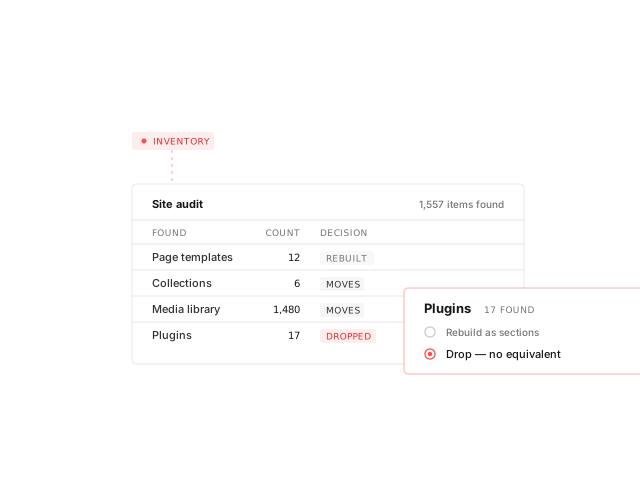
If the hook and access control layer is doing real business logic, that logic has to live somewhere. Find its new home before you start, not after.
Engineer questions
Is BetterCMS an alternative to Payload?
Only if the goal is a running website rather than a CMS you control. Payload is a framework for building a CMS inside your own Next.js application; BetterCMS is a finished product with the editor, hosting, workflow and agent included.
If your engineers want to own the code, Payload is the better choice and we say so on calls.
Is BetterCMS cheaper than Payload?
Not against a free licence. Payload is MIT licensed and free to self host with no seat or API fees, and Payload Cloud runs from $35 to $199 a month. Checked July 2026.
The cost that does not appear on either pricing page is engineering time: building the admin surfaces, running the deployment and patching it. For a team without those hours, a subscription is usually the cheaper number. For a team that has them, it is not.
Does Payload have a visual editor?
No. Payload has an admin panel where editors fill in fields. There is no editing of the rendered page.
That is the single most common reason a marketing team moves off Payload, and the single most common reason an engineering team stays on it.
Is BetterCMS open source like Payload?
No. BetterCMS is a commercial product and no phrasing makes it open source.
What it offers instead is portability: content reads out over a typed Delivery API, exports cleanly, and the frontend is never locked to us. If owning the source is a hard requirement, Payload is a good product and we will not argue you out of it.
Your next website starts here
See BetterCMS running on your pages, not on a sample site.